


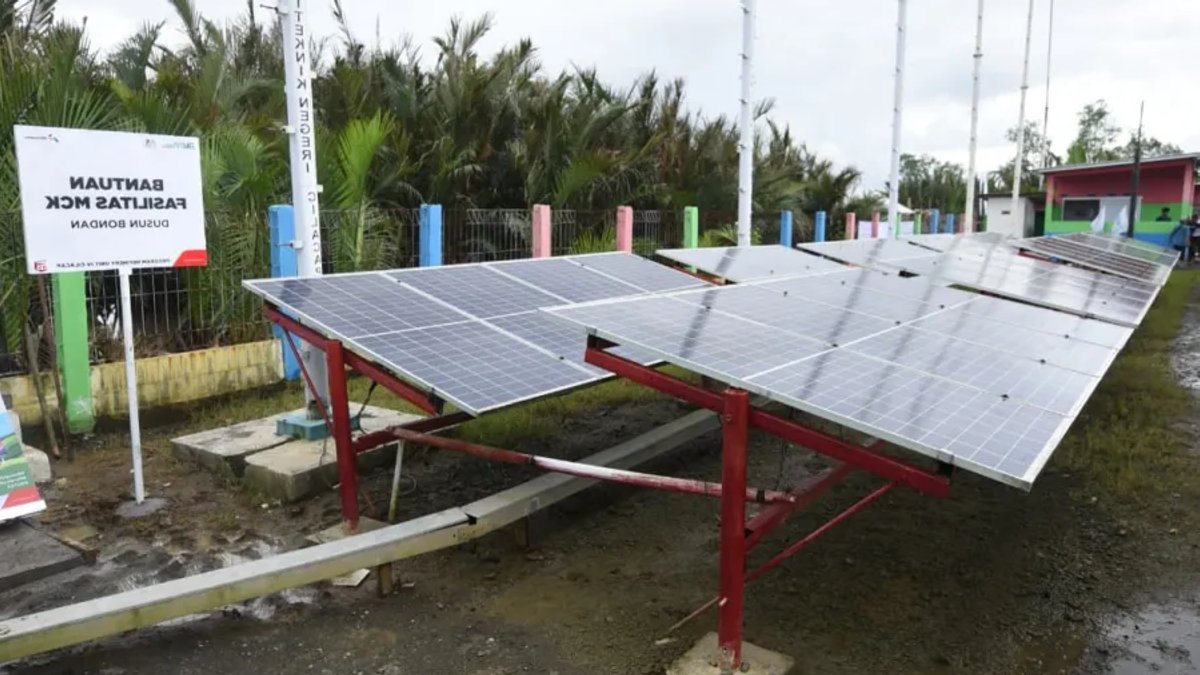
PT Pertamina has launched an ambitious renewable energy initiative in Indonesian villages, connecting power plants to local businesses while reducing emissions and increasing household incomes. The project now serves 310 communities and plans to extend to 732 by 2030, with 60% of those locations outside Java. This expansion targets regions where energy access remains limited, aligning with national sustainability goals.
The programme integrates solar, biogas, micro-hydro, and hybrid systems to support aquaculture, ecotourism, and farming operations. It has already created $1.6 million in annual economic value for more than 283,000 people, according to Rudi Ariffianto, Pertamina’s vice president for corporate social responsibility. The installed systems provide 1.595 million watt-peak of capacity, process 145,000 tons of waste annually, and cut emissions by over 1.1 million tons of CO₂ equivalent. These figures reflect both environmental gains and operational efficiency in rural areas.
In Keliki village on Bali, rice production surged from three to four tons per hectare to seven tons after connecting to the programme’s infrastructure. The system also enabled Bondan, a Central Java community with no electricity until 2017, to install a hybrid plant supplying pond aerators and desalination units. Households there pay just $1.37 monthly to cover operational costs, demonstrating the model’s affordability. Before the project, the village lacked any power supply, leaving businesses and homes dependent on kerosene or manual labor.
Related Post: Tragic Decline of Port Harcourt: From Garden City to Ghost Town
Tumpak village in Central Lombok now sustains 60 local jobs across livestock farming, ecotourism, and coconut production, generating approximately $3,295 annually for participants. A 6.6-kilowatt-peak solar installation powers these activities, while nearby tourism sites, including Uma Palak in Denpasar and Kampung Kepiting in Cilacap, report higher revenues of $30,000 and $33,000 per year, respectively.
Participating villages collectively produce over 21,000 metric tons of rice and 5,000 metric tons of non-rice crops annually from 2,000 hectares of farmland, alongside 390 tons of fish. The programme has also certified 223 residents to operate and maintain renewable energy systems, ensuring long-term community control over the infrastructure. This local expertise reduces dependency on external support while reinforcing sustainability.


