


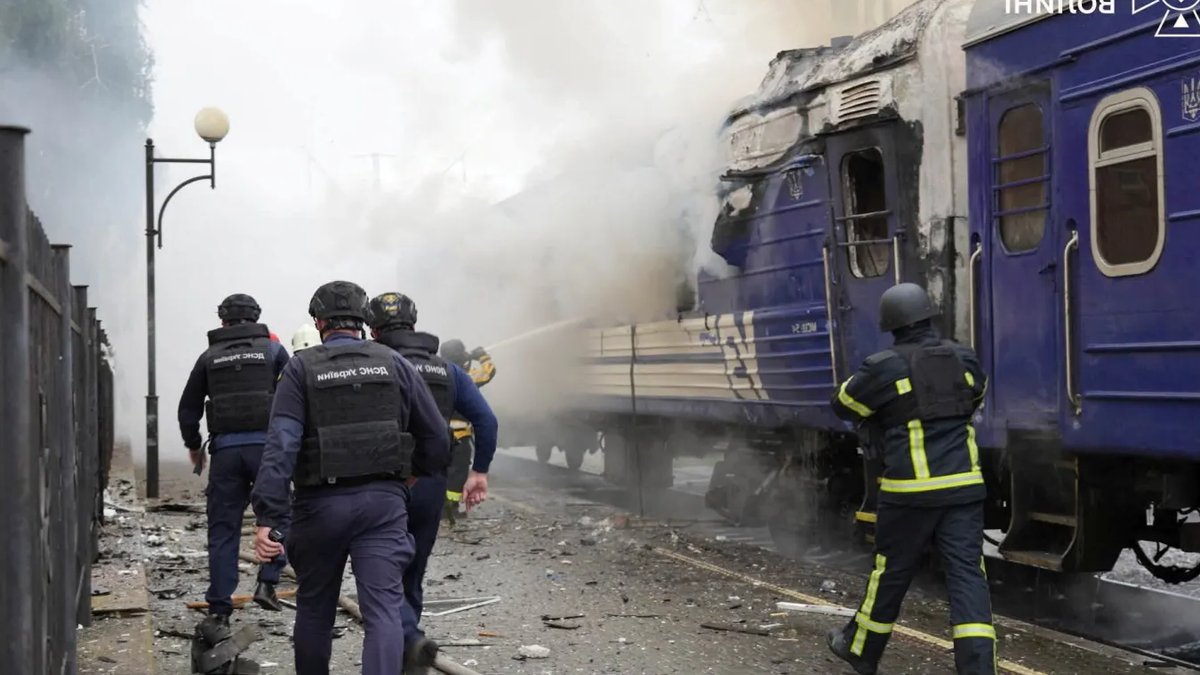
A Russian drone struck a Ukrainian train near the Polish border on Sunday, September 13, shortly after former British Prime Minister Boris Johnson and senior European security officials had travelled along the same railway line. The strike hit the locomotive at Yahodyn, close to Ukraine’s border with Poland. No casualties were reported after passengers were evacuated, according to Ukrainian authorities.
The incident occurred as Russia continued a broad aerial campaign against Ukraine involving drones and missiles. The timing has drawn particular attention because Johnson, senior European security officials and former CIA Director David Petraeus were among Western figures travelling through the area around the time of the attack.
Ukrainian state railway operator Ukrzaliznytsia said the train carrying the European officials had departed earlier than expected because of continuing Russian strike threats. It said it was “quite possible” that the diplomatic train itself had been the intended target, although there is no independent confirmation that the Russian drone was specifically targeting Johnson or the other officials.
Diplomatic Train Targeted Near Polish Border
Russia said it had targeted railway infrastructure. The drone struck approximately two kilometres from the Polish border, bringing the incident unusually close to NATO territory. Polish Prime Minister Donald Tusk called an emergency meeting as officials assessed the incident.
Read Also: Face-to-Face Sales Gain Value in Automated Era
According to the report, the attack was part of a wider increase in Russian strikes around Ukrainian border crossings and logistical routes connected to European support for Ukraine. The episode illustrates the security risks facing foreign officials travelling through Ukraine even on established diplomatic and civilian routes.
But the location and timing have intensified concerns in Kyiv and European capitals about attacks on transport infrastructure used by civilians, diplomats and international delegations. The strike also occurred during one of the most intense periods of Russian aerial attacks in recent weeks.
Russia has increased its use of ballistic missiles and jet-powered drones as Ukraine faces shortages of air-defense interceptors. The train attack follows another incident that has intensified scrutiny of Russia’s behavior around diplomatic activity. On Sept. 8, Russian missiles and drones struck Kyiv after a temporary halt in attacks that had coincided with the visit of U.S. peace negotiators Jared Kushner and Steve Witkoff.
U.S. Envoy Visit Follows Missile Strike on Kyiv
The attack killed five people and injured dozens, according to Ukrainian authorities. Buildings including a school, clinic and residential structures were damaged. The U.S. envoys had left Kyiv two days earlier following meetings with Ukrainian officials as Washington sought to revive negotiations aimed at ending the war.
Read Also: Former Nasdaq Director Convicted of Securities Fraud
One of the clearest precedents came in April 2022, when United Nations Secretary-General António Guterres was visiting Kyiv. Guterres had travelled to Ukraine after meeting Russian President Vladimir Putin in Moscow. On April 28, 2022, he met Ukrainian President Volodymyr Zelenskyy and visited Bucha, Borodianka and Irpin, where he condemned the destruction and called for accountability.
While Guterres was in Kyiv, Russian rockets struck the city. The United Nations later recorded that Kyiv was hit by two rockets during the secretary-general’s visit. Guterres said he was shocked by the attack and said it demonstrated the need to end the war. The Minsk agreements of 2014 and 2015 were designed to stop fighting in eastern Ukraine and establish a political framework for resolving the conflict.
The agreements repeatedly failed to produce a durable ceasefire. Fighting continued in the Donbas, with Russia-backed separatists and Ukrainian forces accusing each other of violations. The breakdown became decisive in February 2022, when Putin recognized the Russian-backed separatist entities in Donetsk and Luhansk and then launched Russia’s full-scale invasion of Ukraine.
Nuclear Pact and Security Assurances Breached by Russia
The 1994 Budapest Memorandum is another major part of the dispute. Ukraine agreed to give up the nuclear weapons it inherited after the Soviet Union collapsed. In return, Russia, the United States and Britain committed to respect Ukraine’s independence, sovereignty and existing borders and to refrain from the threat or use of force against Ukraine.
Read Also: U.S. sees earliest snowfall records ahead of winter outlook
Russia’s seizure of Crimea in 2014 and its subsequent military intervention in eastern Ukraine fundamentally breached those security assurances from Kyiv’s perspective. Russia’s full-scale invasion in 2022 went considerably further. In 2022, Turkey and the United Nations helped broker the Black Sea Grain Initiative, allowing Ukrainian agricultural exports to move through designated maritime corridors despite the war.
The agreement helped restore Ukrainian grain exports to global markets. Russia withdrew from the arrangement in July 2023, arguing that commitments concerning Russian agricultural exports and fertilizer had not been adequately implemented. Ukraine and its Western partners disputed Moscow’s justification. Humanitarian corridors have also repeatedly failed, with attempts to establish corridors for civilians trapped in cities such as Mariupol being contested by both sides.
The safety of those corridors repeatedly became contested, with Ukraine accusing Russian forces of shelling evacuation routes and Russia making counter-accusations against Ukrainian forces. The United Nations has repeatedly stressed the need for safe humanitarian access rather than relying on informal assurances. As the conflict continues, the need for a reliable and safe humanitarian corridor remains a pressing concern.


