


Finding a China Top Spring Coiling Machine For Automotive Seating System Manufacturer that meets the rigorous demands of seat‑component production starts with a clear view of the end product, not just the catalog.
Key Spring Requirements for Seating Applications
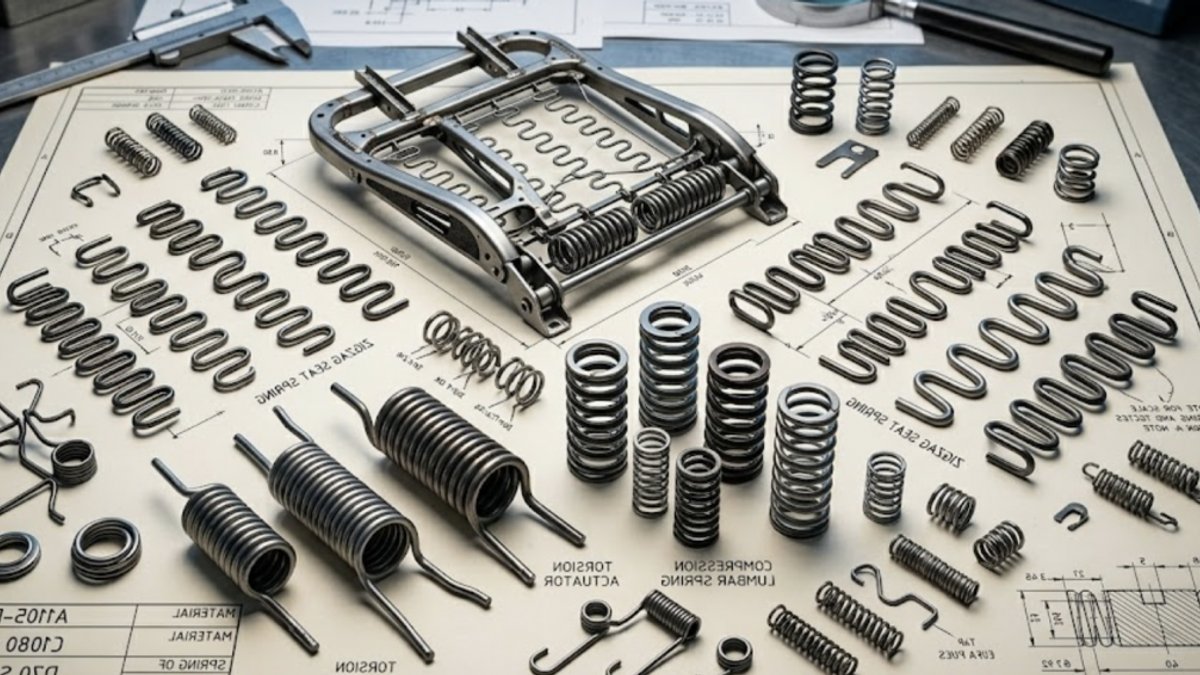
Seat cushion compression springs must endure millions of load cycles while keeping a stable force curve. Backrest torsion elements face temperature swings from –40 °C to +80 °C and still need to avoid permanent set. Zigzag, or serpentine, springs require a uniform pitch to spread load evenly across the base.
Related: CGS Infotech partners with Swami Vigyananand on tech initiative
These functional goals push equipment toward tight wire‑feed control and stable forming force. Knowing the exact wire size, allowable tolerance and spring type before evaluating any supplier cuts the shortlist dramatically and reduces the risk of costly re‑work after installation.
Matching Machine Architecture to Spring Geometry
Axis count signals forming capability more than quality. A two‑axis high‑speed unit handles standard compression springs efficiently, delivering large batches with consistent dimensions. By contrast, a six‑axis CNC system can produce conical, double‑taper or variable‑pitch parts in a single cycle, eliminating secondary operations.
The SMS‑CNC‑660 and SMS‑CNC‑680, built by EASTON PRECISION TECHNOLOGY (DONGGUAN) CO., LTD., illustrate this gap. The X‑axis feeds wire within ±0.01 mm, the Y‑axis sets coil diameter, and the Z‑axis adjusts pitch on the fly. Three auxiliary axes manage end closing, cutting and multi‑angle bending, allowing complex geometries for lumbar supports or headrest adjustments without extra tooling.
Related: Tragic Decline of Port Harcourt: From Garden City to Ghost Town
For a supplier, the ability to switch from a simple base spring to a variable‑pitch lumbar component on the same line can mean the difference between a smooth production flow and a bottleneck.
Material Compatibility and Wire Range
Wire diameter choices link directly to spring function. Heavier gauges support passenger load in cushion bases, while lighter wire delivers the precise force gradients needed in adjustment mechanisms. Headrest springs often sit in a middle band.
The SMS‑CNC‑660 handles 2.5 mm to 6.0 mm wire, with a maximum coil diameter of 110 mm. The SMS‑CNC‑680 works with 3.0 mm to 8.0 mm wire and reaches 120 mm outer diameter. Both models process carbon steel.
Related: 2025 Budget Stacked with Debt and Salaries
Industry 4.0 Readiness and Supplier Checklist
Today’s automotive OEMs expect full traceability from component suppliers. Machines must log production data, support fault detection with automatic stops and allow remote diagnostics.
The six‑axis coiler logs each spring’s parameters and can interface with MES and ERP systems, providing the data needed for quality audits. A graphical programming interface lets engineers store spring libraries and switch between runs with minimal effort.


